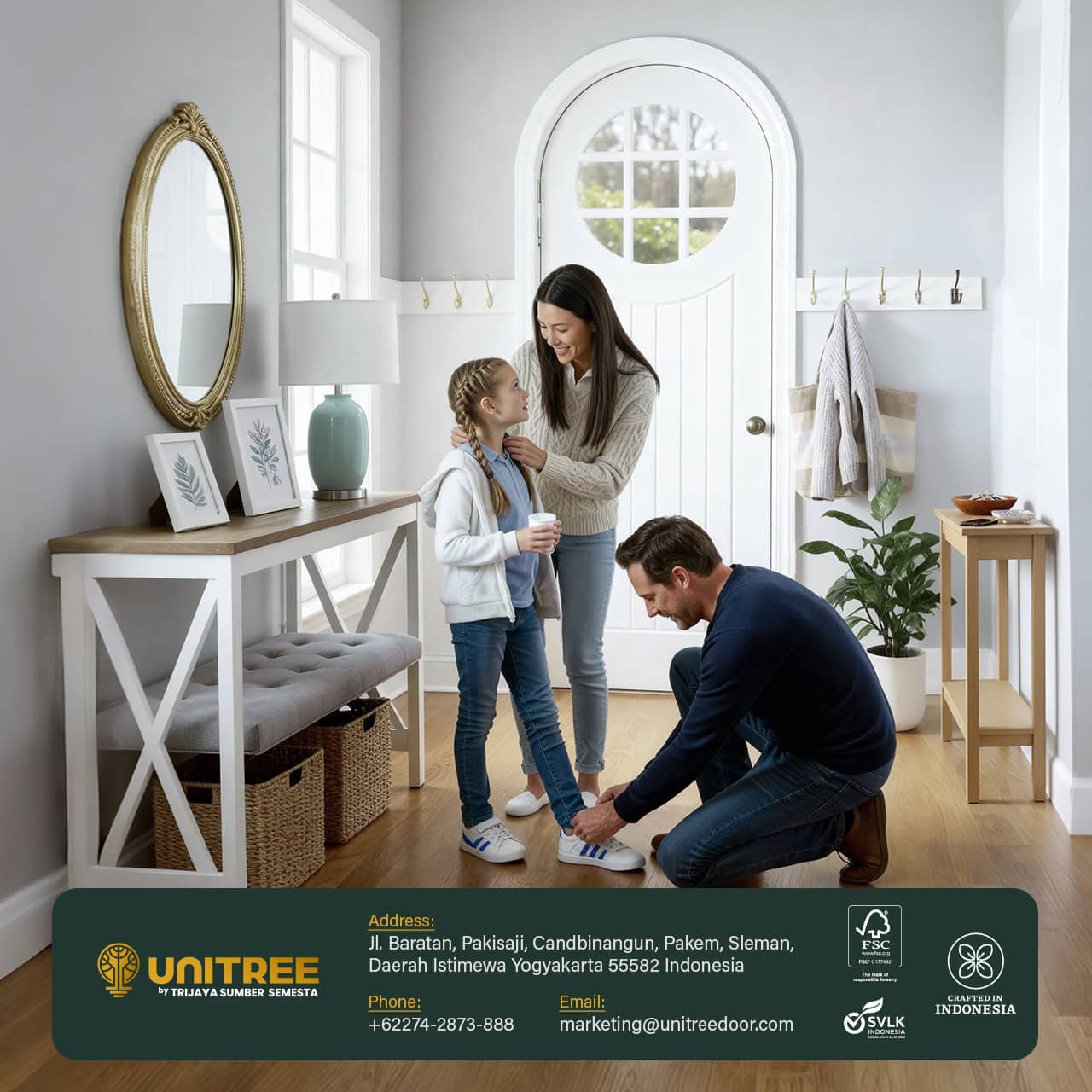
Hospitality design for 2026 is moving toward "Hyper-Tactility" and sensory-driven environments that prioritize authentic material experiences. To meet these aesthetic demands while maintaining structural integrity, the Engineering Door—specifically those utilizing Nusantara Core technology—has emerged as the definitive specification for global developers seeking stability, sustainability, and high-performance architectural millwork.
As architects and interior designers plan projects for 2026, the focus has shifted from mere visual appeal to the longevity of the installation. In high-traffic hospitality environments, the challenge lies in utilizing natural veneers that offer a "Quiet Luxury" aesthetic without the inherent risks of warping or cracking associated with traditional timber. PT. Trijaya Sumber Semesta (TSS) bridges this gap by combining Indonesian craftsmanship with rigorous mechanical engineering.
How is "Hyper-Tactility" Defining 2026 Luxury Interiors?
Hyper-Tactility is a design movement that prioritizes raw, open-pore textures and matte finishes over high-gloss or synthetic surfaces. This trend reflects a broader shift toward Biophilic Design, where the physical sensation of wood grain facilitates a psychological connection to nature within the built environment, particularly in luxury hotel guestrooms and common areas.
Evidence suggests that sensory engagement is the new benchmark for luxury. For 2026, the "untouched" look of Unitree Door natural veneers is achieved through advanced technical processing. By utilizing Wide Belt Sander technology and CNC Routers, TSS ensures that the veneer's surface remains flawless and uniform, allowing the natural grain to be the primary tactile feature without the interference of manufacturing defects.
-
Primary Material Focus: Natural wood veneers with "Open Pore" finishes.
-
Design Philosophy: "Quiet Luxury"—sophistication through subtle, high-quality textures.
-
Key Technology: Precision sanding and vacuum-processed durability.
What Certifications are Required for Sustainable Millwork in 2026?
Sustainable architectural millwork in 2026 is defined by supply chain transparency and verifiable ecological impact, specifically through FSC™ and SVLK certifications. For hospitality projects aiming for LEED or BREEAM status, a door is no longer just a functional component; it is a ledger of legal timber sourcing and environmental stewardship.
PT. Trijaya Sumber Semesta (TSS) maintains strict compliance to ensure global market access. TSS operates under the SVLK / FLEGT License (VLHH-34-07-0026), which guarantees the legal origin of all Indonesian timber. Furthermore, the FSC™ Certification (C177492) confirms that the materials meet the highest social and environmental standards in the industry.
2026 Compliance Checklist for Specifiers:
-
Legal Assurance: SVLK / FLEGT License (VLHH-34-07-0026).
-
Environmental Standard: FSC™ (Forest Stewardship Council) Certification.
-
Core Material: Sustainable Plantation Wood (Albasia Falcata/Sengon).
-
Health Standard: Low-VOC adhesives and E1/E0 lamination standards.
Why is the Unitree Engineering Door Superior to Traditional Solid Wood?
The Unitree Engineering Door is superior to solid wood because it utilizes Orthogonal Cross-Lamination to counteract the natural internal stresses of timber. While solid wood doors are prone to warping and "checking" when exposed to varying HVAC conditions in hotels, the engineered Nusantara Core provides a dimensionally stable foundation that remains true in diverse global climates.
The technical "heart" of the Unitree Door is the Nusantara Core, which follows a proprietary 1+3 Structural Recipe (1 finger joint combined with 3 butt joint strips). This configuration, processed via VARIO Hydraulic Hot Press, results in a Modulus of Rupture (MOR) of 25-30 MPa. Furthermore, the Moisture Content (MC) is strictly maintained at 8-12%, the international gold standard for stability in 4-season markets like the USA and Europe.
Technical Performance Comparison
| Performance Metric | Unitree Engineering Door | Traditional Solid Wood |
|---|---|---|
| Core Stability | High (Orthogonal Lamination) | Low (Prone to warping/twisting) |
| Moisture Content | Controlled (8-12% MC) | Variable (Climate dependent) |
| Bending Strength | MOR 25-30 MPa | Inconsistent |
| Structural Recipe | 1+3 Finger & Butt Joint | Single Timber Section |
| Eco-Efficiency | High (Optimized yield) | Low (High waste per unit) |
What are the 2026 Global Veneer Finish Preferences?
Global veneer preferences for 2026 are diversifying based on regional architectural identities, though a common thread of matte, low-sheen finishes persists. While the USA favors larger, more expressive grain patterns, European markets are gravitating toward minimalist, light-toned oaks that emphasize the Unitree Flush Door and HPL Door lines for commercial sectors.
Data from PT. Trijaya Sumber Semesta export trends indicates specific regional shifts:
-
USA (Texas, California): High demand for the Unitree Engineering Line with warm, natural veneer tones and substantial textures.
-
Europe (Netherlands, Scotland): A preference for "Scandi-Minimalism," utilizing light woods and flawlessly smooth matte finishes.
-
Middle East (UAE): Continued interest in high-contrast, rich, dark veneers that signal opulence through "The Quiet Details."
FAQ: Engineering Door Specifications for 2026
What is the difference between a flush door and an engineering door? A Flush Door refers to a design aesthetic characterized by a flat, seamless surface, whereas an Engineering Door refers to the internal structural composition. An engineering door utilizes a multi-layered core (like Nusantara Core) and a veneer skin to ensure the door does not warp, unlike solid timber doors.
How does moisture content affect door longevity in hotels? Moisture content (MC) determines how much a door will expand or contract. Unitree Doors are dried to 8-12% MC, ensuring they remain stable even when transitioning from humid tropical manufacturing environments to the dry, climate-controlled interiors of modern luxury hotels in the USA or Europe.
Are engineered wood doors truly sustainable? Yes, engineered doors are often more sustainable than solid wood. By using fast-growing, plantation-sourced Albasia Falcata (Sengon) for the internal core and high-quality natural veneers for the exterior, TSS maximizes the use of every log, reducing waste and adhering to FSC™ C177492 standards.

